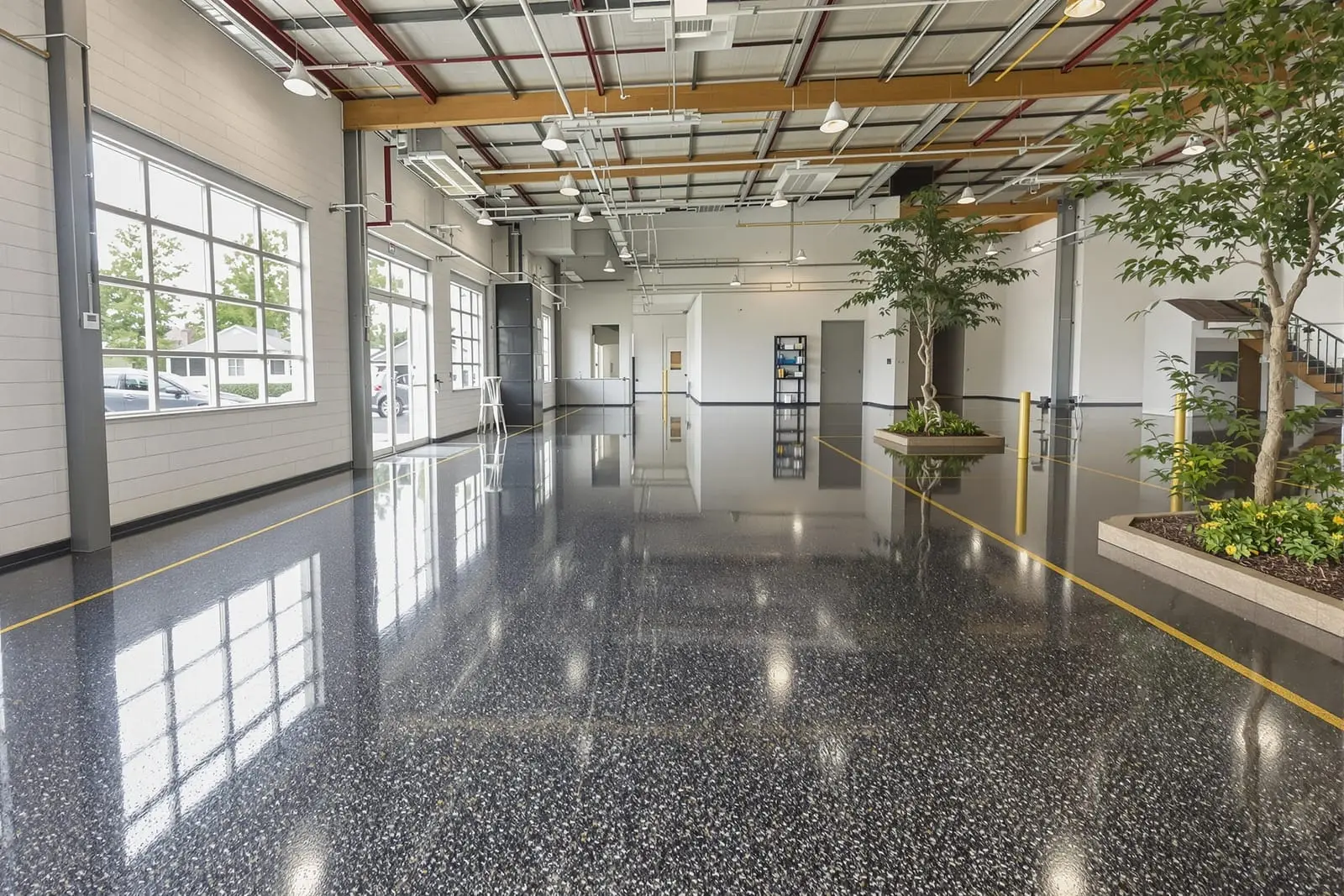
Support heavy operations with industrial concrete floors in Columbus, OH. We pour high strength slabs designed for forklifts, racks, and machinery. Proper thickness, reinforcement, and joint planning reduce cracking. Keep your warehouse running smoothly with durable, low maintenance concrete surfaces.
Primetime Concrete Columbus provides professional industrial concrete floors throughout Columbus, OH and the surrounding area. Our licensed, insured crew delivers safe, clean, on-time work with a free estimate before anything begins. Call (614) 826-6493 or request your free quote.
Durable industrial concrete floors built for real Columbus warehouses
Industrial concrete floors are not just thicker versions of a garage slab. In a warehouse or manufacturing space around Columbus, your floor has to carry forklifts, pallet racking, point loads from machinery, and still stay level and safe over time. At Primetime Concrete Columbus, we start every warehouse and industrial floor project by asking how your space will actually be used: what equipment runs on it, how heavy your racks are, whether you are using narrow aisle reach trucks, and what kind of traffic patterns you expect.
Local soil and weather affect your floor more than most people realize. Much of the Columbus area has clay soils that hold water, so we pay close attention to subgrade preparation and drainage. Freeze and thaw cycles, especially in older unheated or partially heated buildings, can move poorly prepared slabs and create trip hazards and joint spalling. We design your industrial concrete floor with those realities in mind, from the stone base under the slab to the joint layout on the surface.
Instead of a one size fits all approach, we size slab thickness, reinforcement, and joint spacing to your actual loads. A light distribution warehouse with pallet jacks needs something different than a stamping facility with heavy presses. Primetime Concrete Columbus walks you through these choices in plain language so you understand what you are paying for and what kind of performance to expect over 5, 10, or 20 years.
How we install warehouse and industrial concrete floors step by step
A successful warehouse floor starts before any concrete hits the ground. First, our crew evaluates and prepares the subgrade. We remove soft spots, compact the soil, and install a crushed stone base, typically 4 to 8 inches depending on building conditions and load needs. In many Columbus industrial parks there are old fill areas or previous utility trenches. We identify those and over excavate or recompact them so you do not get differential settlement later.
Next, we address moisture and vapor. If the floor will receive epoxy, polished concrete, or sensitive coatings, we usually recommend a vapor barrier under the slab and sometimes moisture testing in existing buildings. Many older Columbus warehouses do not have a proper vapor barrier, which is why coatings peel or tiles pop. When we are working in a retrofit, we explain what is realistic to fix and what might require mitigation.
Reinforcement is tailored to your needs. For most industrial concrete floors we use a combination of rebar at key locations and synthetic or steel fibers in the mix to control cracking. We design joint spacing and layout around your racking and traffic patterns, so lift truck wheels are not constantly hitting joints. For very high traffic aisles, we can discuss doweled construction joints and specialty joint fillers that stand up to hard wheel impacts.
On pour day, we place concrete using laser screeds or walk behind screeds to achieve a flat, level surface suitable for racking and forklift traffic. Finishing is timed carefully so the surface is hard enough to support power trowels but not so dry that it dusts. In larger warehouses we often burnish the surface with multiple trowel passes to create a dense, abrasion resistant finish that cleans easily and stands up to tire wear.
After finishing, we cut control joints at the right time, usually within 6 to 18 hours depending on temperature and humidity. We saw to proper depth to encourage controlled cracking at the joints instead of random cracks across the slab. Then we apply a curing compound or, if specified, a curing and sealing product to lock in strength. We coordinate with you on traffic restrictions, since heavy forklift use generally needs to wait a few days even though foot traffic can start sooner.
Options for heavy duty, hygienic, and specialty industrial concrete floors
Not every warehouse or industrial facility in Columbus needs the same floor surface. Primetime Concrete Columbus helps you choose finishes and treatments that fit how you operate, your cleaning routine, and your safety requirements.
For heavy forklift traffic and long aisle racking, we typically recommend a hard troweled surface with a penetrating sealer. This gives you a dense, low dust surface that performs well with rubber or polyurethane tires. If you have high visibility areas, such as a distribution center that hosts customer tours, we can mechanically polish the concrete to a low, medium, or high sheen. Polished industrial concrete floors resist staining better, reduce dust, and can often eliminate the need for separate floor coverings.
If your operation involves oils, solvents, or food products, we may suggest a combination of a well prepared concrete base and a specialty coating system installed by a coatings partner. The key is getting the base slab right: correct vapor protection, no weak surface laitance, and joints that are detailed properly so the coating will not fail. We plan sawcut locations so they work with coating details and, where needed, we install keyways or dowels to limit vertical movement at joints.
For manufacturing facilities with heavy point loads, like machinery pads or tank foundations, we can thicken the slab in specific areas or pour isolated equipment pads monolithically with the main floor. This keeps costs in check while putting strength where it actually matters. We can also install formed trenches, drains, and sloped washdown areas when sanitary or process water management is important.
In cold storage or conditioned warehouses, insulation and temperature swings matter. While most Columbus warehouses are ambient temperature, more operators are adding refrigerated zones or dock seals. In those cases, we pay attention to condensation, slab curling risks, and the choice of joint fillers that stay flexible in cooler environments. These details often get overlooked and are a big reason some floors fail early.
What drives cost and timeline for industrial concrete floors in Columbus
Industrial concrete floor pricing is driven by several practical factors, not just square footage. Slab thickness and reinforcement choice are the biggest cost drivers. A 6 inch fiber reinforced slab for light warehouse use costs significantly less than an 8 or 10 inch slab with heavy rebar, dowel baskets, and specialty joint systems for very high rack loads. At Primetime Concrete Columbus, we try to match the design to your actual needs so you are not overpaying for strength you will never use or underbuilding a floor that will give you trouble later.
Existing site conditions also affect cost. If we discover poor soils, buried debris, or old foundations in your Columbus property, we may need extra excavation, stone, or engineering to stabilize the base. Working in an active facility instead of an empty shell adds complexity too. Often we schedule phased pours around your operations, set up dust control, and coordinate material deliveries around your dock schedule. This can lengthen the timeline slightly but lets you keep running.
Weather and season matter in central Ohio. Spring and fall are ideal for many projects because temperatures are moderate and humidity is manageable. Summer heat means we need to adjust mix designs, set up wind breaks, or add curing aids so the surface does not dry too fast and dust. In winter, we can still pour indoors if we can maintain a reasonable temperature in the building and protect the concrete from freezing during the early curing period. Temporary heat and insulation blankets are sometimes required, which can add cost but are far cheaper than dealing with a damaged slab.
Lead times depend on project size and engineering. A small equipment pad or partial warehouse replacement might be scheduled within a couple of weeks. Full facility floors in new construction often involve collaboration with your architect or structural engineer and may require shop drawings, which adds a design phase. We are upfront about schedule impacts and help you understand when racking installation, coatings, or tenant move in can realistically occur without risking damage to a young slab.
Common floor problems and how Primetime Concrete Columbus prevents them
Many of the calls we get are from owners frustrated with floors that dust, chip at the joints, or show random cracking. Most of these problems started long before they noticed anything. Poor base prep, inadequate joint layout, rushed finishing, or lack of curing are common issues in industrial concrete floors that were installed on a tight bid without enough attention to detail.
Random cracking often comes from joints that are spaced too far apart, placed at odd angles to the building layout, or cut too shallow. At Primetime Concrete Columbus, we design joint patterns around column lines, door openings, and racking aisles, then cut to the proper depth based on slab thickness. We also treat joints as critical details, not an afterthought. On heavy forklift routes we use dowels and high performance joint fillers that can handle constant impact so the edges do not spall.
Dusting and surface weakness usually relate to finishing and curing. If the surface is worked while bleed water is still present or allowed to dry out too fast, the top layer becomes weak and can break down under traffic. We control mix water, watch bleed off times, and time the trowel passes so we get a dense surface without overworking it. Then we apply curing compounds or, where specified, use curing methods compatible with future polishing or coatings.
Settlement around racks or machinery often goes back to inconsistent subgrade compaction or hidden fill. In Columbus, where some industrial sites have been redeveloped multiple times, we take soil conditions seriously. We probe suspect areas, bring in additional stone where needed, and compact in thin lifts to achieve uniform support. When you need to add new racking or machinery in an existing warehouse, we can assess the current slab, perform cores if needed, and recommend reinforcement or localized thickened sections for any new work.
Our goal is to help you end up with an industrial concrete floor that you do not have to think about every day. By addressing design, preparation, installation, and early age care intentionally, we reduce surprises and extend the service life of your warehouse or industrial space in Columbus.
“
Professional warehouse & industrial concrete floors, done right the first time, quality materials, honest pricing, and results that last.
Primetime Concrete Columbus
Warehouse & Industrial Concrete Floors Across Our Service Area