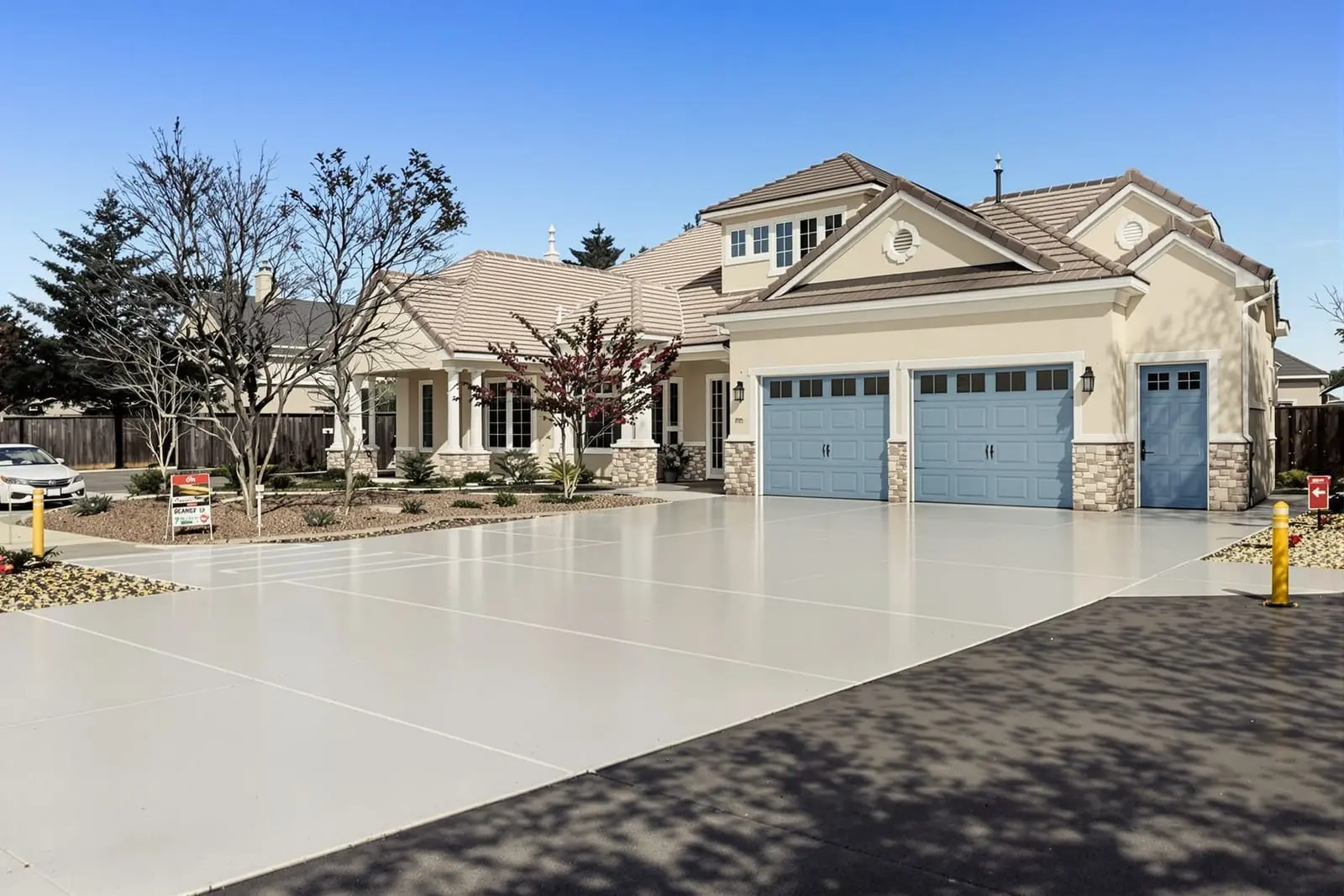
Support your business with durable commercial concrete paving in Columbus, OH. We install parking areas, access drives, dumpster pads, and loading zones designed for heavy traffic. Our team coordinates around your operations to minimize downtime while delivering strong, long lasting surfaces.
Primetime Concrete Columbus provides professional commercial concrete paving throughout Columbus, OH and the surrounding area. Our licensed, insured crew delivers safe, clean, on-time work with a free estimate before anything begins. Call (614) 826-6493 or request your free quote.
Commercial Concrete Paving for Columbus Properties
Primetime Concrete Columbus provides commercial concrete paving built for the way Columbus properties are actually used. We focus on durability under heavy vehicle traffic, freeze-thaw cycles, and frequent snow and ice control. Whether you manage a plaza on Polaris Parkway, an industrial site near Rickenbacker, or a small retail center on the west side, the paving needs are different and we design for those specifics.
Commercial concrete paving is not just a thicker version of residential work. We account for truck routes, dumpster pads, loading dock approaches, fire lanes, and ADA access in our layout and thickness. We choose mix designs that handle de-icing salts used by local plow contractors and city crews, which is critical if you want pavement that still looks solid after several Ohio winters.
When you call Primetime Concrete Columbus, we walk the site with you, look at drainage paths, existing subgrade conditions, and how traffic actually moves on the property. We then recommend pavement thickness, joint layout, and reinforcement that match those conditions instead of using one standard section for every job.
How Our Commercial Concrete Paving Process Works
For commercial concrete paving projects around Columbus, our work starts with investigation, not demolition. We identify unstable subgrade, poor drainage, and existing utilities before we bring in heavy equipment. In older areas like Italian Village or the Brewery District, we are especially careful about shallow utilities and unknown prior repairs.
We then handle removal and subgrade preparation. This includes milling or breaking out old pavement, hauling debris to an approved facility, and grading to create proper slopes. In the Columbus area, clay soils are common, so we often recommend proof-rolling to locate soft spots that need undercutting and replacement with compacted aggregate. On loading areas and access drives, we usually install a thicker stone base and verify compaction with a plate or nuclear density gauge.
Once the base is ready, we set forms or slip-form where appropriate, install reinforcement (wire mesh, rebar, or dowel baskets at construction joints), and place the concrete. Our crews use commercial mix designs with appropriate air entrainment for freeze-thaw protection. We finish the surface with a broom texture that gives traction in wet and icy conditions, then cut joints at calculated spacing to control cracking. Finally, we cure the slab using curing compound or wet cure methods so the concrete reaches design strength, which is critical before you put heavy vehicles on it.
Design Options: Thickness, Reinforcement, and Layout
Commercial concrete paving design starts with what will drive or park on it. For regular car traffic at an office park, a 5 to 6 inch slab may be appropriate. For service lanes, dumpster pads, and delivery truck routes, we often step up to 8 inches or more, sometimes with thicker sections at concentrated load points. Primetime Concrete Columbus does not guess at these numbers. We use your expected traffic weights and frequency to recommend a design that will hold up without overspending.
Reinforcement choices depend on slab size and loading. For many parking areas we use welded wire reinforcement with doweled joints at drive lanes. For heavy loading zones, we often specify rebar mats or closely spaced bars tied to match the joint layout. This controls curling and helps keep joints tight under repeated truck loads.
Joint layout is another critical design decision. Random cracking on a commercial property looks bad and can become a maintenance issue. We plan saw-cut joints on a grid that matches parking stripes, light poles, and islands as much as possible, so the pavement looks intentional and is easier to maintain. We also plan thickened edge sections where pavement meets catch basins, building entrances, or dock aprons so those high stress areas do not break down first.
Material Choices and Surface Finishes for Commercial Use
For Columbus commercial concrete paving, the mix itself is as important as the thickness. We typically use a minimum 4000 psi air entrained mix, and often higher strength mixes for heavy-duty areas. Proper air content helps the concrete handle freeze-thaw cycles and the use of de-icing salts that are common on central Ohio properties from November through March.
We discuss surface finish with you based on how the area will be used. For parking lots and drive aisles, a medium broom finish is usually best. It provides slip resistance in rain and snow without being too rough for pedestrians or carts. Around entries, walkways, and plazas, we can tighten the surface with a light broom or trowel and still maintain traction, so employees and customers are less likely to slip in winter conditions.
Color and decorative treatments are options in certain commercial settings. In mixed-use developments we can use integral color, borders, or scored patterns to separate walkways from drive lanes or to highlight crosswalks. When aesthetics are less important than performance, like at industrial yards or warehouse aprons, we focus instead on finish that sheds water correctly and resists abrasion from forklifts, trailers, and pallet jacks.
What Drives Cost and How to Control It
Several specific factors impact the cost of commercial concrete paving around Columbus, and understanding them helps you budget realistically. Pavement thickness and total square footage are the obvious drivers, but subgrade conditions, access, phasing, and reinforcement all play a major role.
Unstable or saturated subgrade can change pricing quickly. Sites near rivers or low-lying ground, or older lots that have been patched many times, often have weak areas that need undercutting and replacement with compacted aggregate. We will point this out during the site walk and, where possible, give you options like phased undercut or geogrid reinforcement to reduce cost while still achieving a stable base.
Access and phasing also affect cost. If your business must stay open, we can phase the commercial concrete paving so that parts of the lot remain usable while others are being reconstructed. This sometimes means more mobilizations and joint lines, which affects price, but avoids lost revenue or tenant complaints. For downtown or tight urban sites where truck and pump access are limited, we account for the extra time and equipment in the proposal so there are no surprises later.
To control lifetime cost, we usually recommend strategic upgrades, such as thicker pavement only in drive lanes and loading areas, with standard thickness in low load parking stalls, rather than overbuilding the entire lot. We also stress proper curing and a realistic opening schedule. Letting concrete reach adequate strength before putting heavy traffic on it prevents early damage that would be far more expensive to correct.
Columbus Timing, Maintenance, and How to Get Started
Central Ohio weather dictates when commercial concrete paving can be poured and how quickly it can go into service. In our climate, major paving is usually best between April and early November. Spring and fall can be tricky, with temperature swings from daytime warmth to overnight freezes. Primetime Concrete Columbus plans pours around reliable temperature windows and, if necessary, uses cold weather methods like insulated blankets and adjusted mix designs to protect fresh concrete.
We help you plan timing around tenant or customer schedules too. For retail centers and medical offices, this often means early morning pours or weekend work so access is maintained. On industrial sites, we coordinate with shipping schedules to keep essential truck routes open. Our goal is to complete the work with as little disruption as possible while still meeting curing requirements.
Once the pavement is in service, routine maintenance is straightforward but important. We recommend regular sweeping, prompt removal of leaked oils or chemicals, and, after the first winter, periodic resealing of joints to keep water out of the subgrade. In Columbus, where freeze-thaw cycles are constant, keeping water away from the base helps prevent slab movement and spalling. If you are seeing early signs of distress like localized settlement, joint raveling, or scaling from aggressive de-icers, we can inspect, identify the cause, and recommend targeted repairs before the damage spreads.
To discuss a commercial concrete paving project in Columbus or the surrounding suburbs, you can provide a site plan, traffic information, and any known issues with your current lot. Primetime Concrete Columbus will then propose a design, phasing plan, and schedule that addresses your property’s specific needs instead of forcing it into a generic template.
“
Professional commercial concrete paving, done right the first time, quality materials, honest pricing, and results that last.
Primetime Concrete Columbus
Commercial Concrete Paving Across Our Service Area