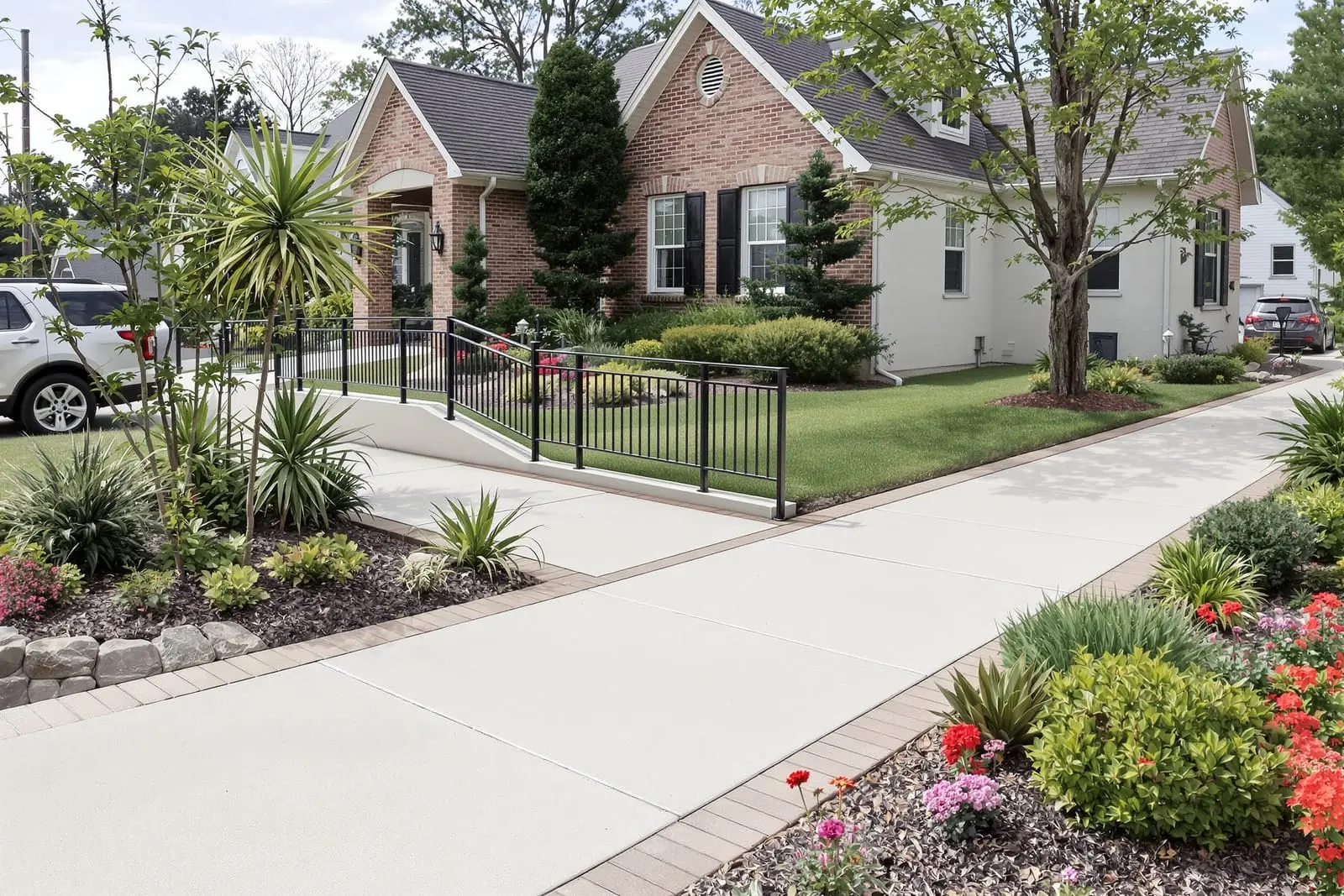
Provide safe access to your building with commercial sidewalk installation in Columbus, OH. We pour walkways and ADA compliant ramps that meet slope, width, and handrail requirements. Our concrete solutions help keep your property accessible and easy to navigate for all visitors.
Primetime Concrete Columbus provides professional commercial sidewalk installation throughout Columbus, OH and the surrounding area. Our licensed, insured crew delivers safe, clean, on-time work with a free estimate before anything begins. Call (614) 826-6493 or request your free quote.
Commercial Sidewalks & ADA Ramps for Columbus Businesses
Primetime Concrete Columbus builds commercial sidewalks and ADA-compliant ramps for businesses, schools, medical offices, and multifamily properties throughout the Columbus area. We understand these walkways are not just concrete; they are part of how customers, tenants, and employees safely reach your doors in all four Ohio seasons.
Our team focuses on three priorities for every project: safety, compliance, and long-term durability. That means getting the slope right so the surface is comfortable to walk and roll on, placing joints correctly so the slab can move without cracking, and using mixes that stand up to central Ohio freeze-thaw cycles, snowmelt chemicals, and heavy foot traffic. Because we work locally, we are familiar with the City of Columbus standards, typical plan review feedback, and how local inspectors interpret ADA ramp guidelines in real situations.
Whether you are adding a new sidewalk to meet a change-of-use requirement or upgrading older, non-compliant ramps before a tenant build-out, we coordinate our work with your schedule and any other trades on site. We routinely work in active retail centers, office parks, and apartment communities while doors stay open and people still need a safe path around the work area.
How Commercial Sidewalk Installation Works, Step by Step
Many commercial property managers know they need new concrete, but are not sure what actually happens onsite. Primetime Concrete Columbus starts with layout, which means verifying widths, ramp landings, slopes, and transitions against plans and ADA requirements. We use laser levels to establish finished elevations so water drains away from buildings and does not pond on the walkway.
Next we excavate to the proper depth, typically removing 6 to 10 inches of soil depending on the sidewalk design and expected traffic. In Columbus we often encounter clay subgrades that hold water, so we pay close attention to compaction. We compact the subgrade and usually place a 4 inch base of compacted 304 crushed stone or similar aggregate to provide drainage and a stable platform.
Formwork follows. We set straight or curved forms to define the sidewalk or ramp edges, double-checking slopes with digital levels. For sidewalks we typically pour 4 inch thick concrete. For areas that will see carts, delivery dollies, or occasional light vehicle loading, we may recommend 5 inch or thicker sections. We place control joints at appropriate spacing, usually every 4 to 6 feet depending on slab thickness, to help control where cracks form.
Concrete placement is continuous once the trucks arrive. We use commercial-grade mixes, often 4000 psi or higher, with air entrainment to handle freeze-thaw stress. Our crew consolidates and strikes off the concrete, then finishes with broom textures that improve traction in rain and snow. Edges are tooled to reduce chipping and to create clean, professional lines.
Finally, we cure the slab using methods suitable for local temperatures and humidity. In hot Columbus summers, we may use curing compounds or coverings to prevent rapid moisture loss. In cooler weather, we plan pours to avoid overnight freezing and may use insulated blankets where needed. Proper curing is one of the biggest factors in how long your sidewalk or ramp will last.
Designing Sidewalks and ADA Ramps That Actually Work On Site
Good commercial sidewalk installation goes beyond pouring a straight strip of concrete. Primetime Concrete Columbus spends time on design details that affect usability and maintenance costs over the life of the property.
For ADA ramps and accessible routes, we verify that slopes stay within current standards, generally a maximum of 1:20 for walkways and 1:12 for ramps, and that cross slopes do not push wheelchairs to the side. We look for conflicts between plans and reality, such as existing door thresholds, utility structures, or curb heights, and suggest adjustments before concrete is ordered.
In high-traffic retail plazas and medical facilities, we often recommend wider sidewalks than the minimum, sometimes 6 to 8 feet instead of 4, to accommodate two-way pedestrian flow, wheelchairs, and strollers. At apartment communities, we focus on connecting parking, entries, mail kiosks, and shared amenities with continuous, accessible paths, so residents do not have to step off onto grass or gravel.
Surface finish is another design choice with practical consequences in Columbus winters. We typically use a medium broom finish that provides grip in snow and slush without being too rough for rolling walkers or carts. At ramps and crosswalk tie-ins, we coordinate with any planned detectable warning surfaces, sometimes called truncated domes, so they integrate cleanly with the concrete and do not become tripping edges.
Lighting, drainage, and landscaping also affect sidewalk performance. We look at where downspouts empty and whether runoff will cross the walk, which can freeze in winter. When needed, we modify grades or add drains to direct water away. We discuss tree placement and root barriers so new plantings will not heave the concrete in a few years.
Meeting ADA and Local Columbus Requirements
ADA rules and local codes can feel confusing if you do not work with them regularly. Primetime Concrete Columbus helps owners, facility managers, and general contractors understand what is required and how it applies to their particular property.
We review the proposed routes to ensure they include the proper combination of ramps, landings, and crosswalk connections. For example, accessible ramps need level landings at the top and bottom and at any turns, with clear space for door swings near entrances. Handrails may be required at certain ramp slopes and lengths, and we coordinate elevations to match railing shop drawings where applicable.
In the Columbus area, inspectors often focus on measurable details such as ramp slope, cross slope, landing size, and vertical changes at joints. We use layout tools that allow us to check and adjust these details before the concrete sets, not after an inspection fails. When existing site constraints make textbook solutions impossible, we work with your design team and, where appropriate, share practical options based on what we have seen accepted on similar local projects.
For older properties catching up on compliance, we help prioritize improvements that will have the biggest accessibility impact, such as correcting steep ramps at main entries, adding curb ramps at key parking areas, and eliminating abrupt changes in level at thresholds and joints. This structured approach is especially useful for shopping centers, churches, and small medical practices that must manage compliance upgrades over multiple budget cycles.
What Drives Cost for Commercial Sidewalks and ADA Ramps
Cost for commercial sidewalk installation and ADA ramps in Columbus is influenced by several factors beyond square footage. Primetime Concrete Columbus walks you through these items so you can compare bids on equal terms.
Site access is a major cost driver. If concrete trucks can back close to the pour area, labor and pump costs stay lower. If the walkway is deep inside a campus or behind existing buildings, we may need a concrete pump or more labor to move material, which adds time and expense. Tight urban locations near downtown Columbus or the Short North often fall into this category.
Existing conditions also matter. Removing thick, deteriorated concrete, working around tree roots, or undercutting soft or saturated soils can increase excavation and base work. In some older Columbus neighborhoods, we find buried debris or poor fill material that requires additional stone base or geotextile reinforcement to ensure long-term stability.
Design complexity affects both material and labor. Curved sidewalks, multiple transitions, integrated steps, or decorative borders require more formwork and finishing skill. ADA ramps with switchbacks, integrated retaining edges, or tie-ins to existing structures require more layout time and precise forming. If you are considering decorative concrete options, such as colored bands or exposed aggregate at entries, we explain how those choices influence both upfront cost and future maintenance.
Finally, job timing and phasing can change pricing. Working nights or weekends to keep an entry open, or splitting a project into many small phases to maintain traffic flow, involves more mobilizations. We help you evaluate whether a faster, more intensive schedule or a slower, phased approach makes better financial and operational sense for your property.
Common Sidewalk and Ramp Problems in Columbus and How We Prevent Them
Local climate and soils create predictable issues for commercial sidewalks and ramps. Primetime Concrete Columbus designs and builds with these in mind so you avoid premature repair or replacement.
Freeze-thaw cycles, deicing salts, and snowplow contact are the biggest threats. To combat this, we use air-entrained concrete mixes that are appropriate for our region, proper thickness for the use, and well-compacted stone base. We set joint spacing and depth to control shrinkage cracking, then emphasize to owners the importance of sealing joints and avoiding aggressive chemicals like ammonium-based deicers that can attack the concrete surface.
In areas with heavy clay soils, poor drainage can lead to settlement and heaving. Before we pour, we evaluate drainage patterns and subgrade condition. Where needed, we remove unsuitable soil, install thicker aggregate base, or add underdrains to move water away. Along building lines, we confirm that final grades slope away from foundations to protect both the sidewalk and the structure.
Heaving from tree roots is common along older Columbus streets and in mature apartment complexes. When sidewalks must pass near large trees, we discuss root pruning and the potential need for root barriers or rerouted paths. Sometimes shifting the walk a foot or two or using a combination of sidewalk and boardwalk segments solves a long-term conflict.
For existing sidewalks and ramps that are already damaged or non-compliant, we provide repair and replacement options. In some cases, selective panel replacement and joint grinding are enough to remove trip hazards and improve drainage without a full replacement. In others, especially where slopes and elevations are wrong, we recommend full removal and reconstruction so the result is both durable and compliant.
Working With Primetime Concrete Columbus on Your Next Project
When you contact Primetime Concrete Columbus about commercial sidewalk installation or ADA ramp work, we typically begin with a site visit. We walk the property with you to understand how people actually move through the space, identify problem areas, and review any plans or city comments you may already have.
From there, we provide a written proposal that outlines the scope, materials, thicknesses, base preparation, and any phasing required to keep access open. If you are a general contractor, we coordinate with your schedule, other trades, and inspection milestones. If you are a property owner or manager, we help you develop a plan that fits your budget and your tenants operational needs.
During construction, we communicate daily about access routes, concrete pour times, and cure periods. For busy Columbus retail and office sites, we often set up temporary pedestrian paths with signage so customers and staff have a clear, safe way around work zones. We keep work areas as clean as possible and coordinate with your snow removal or landscaping vendors when schedules overlap.
After the work is complete, we walk the project with you, discuss curing and the right time to resume full use, and provide guidance on seasonal maintenance and deicing practices. Our goal is that your new commercial sidewalks and ADA ramps perform well through many central Ohio winters and continue to look professional for years.
If you are planning a new commercial building, refreshing an older center, or responding to an ADA review, Primetime Concrete Columbus is ready to help you plan and deliver concrete work that fits the way your property is actually used, not just how it looks on paper.
“
Professional commercial sidewalks & ada ramps, done right the first time, quality materials, honest pricing, and results that last.
Primetime Concrete Columbus
Commercial Sidewalks & ADA Ramps Across Our Service Area